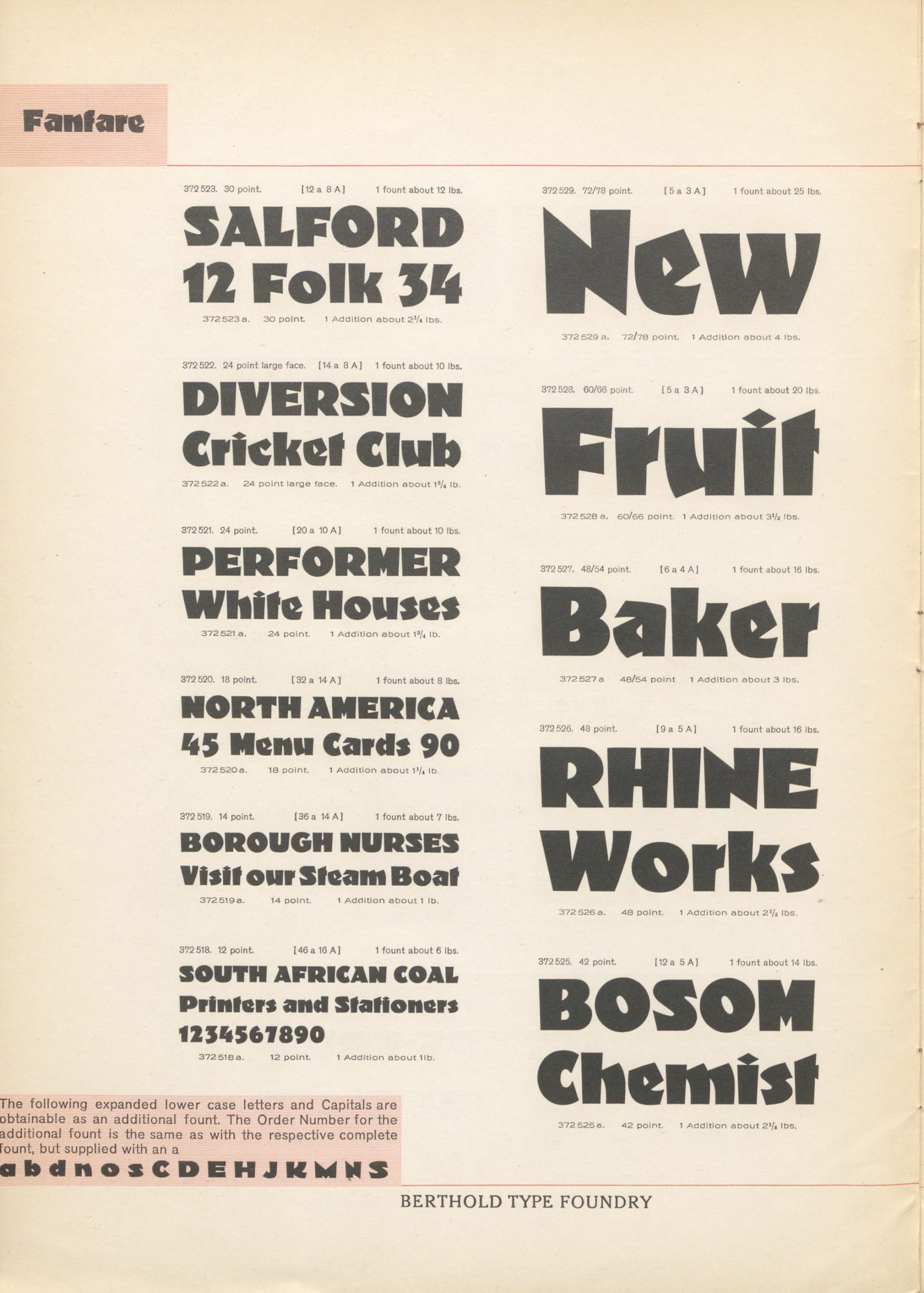

Page from a historic type specimen book showing the Fanfare typeface

Berlin's typographic heritage

Historic type specimens and brochures digitised in accordance with the DFG practical guidelines.

Page from a historic type specimen book showing the Fanfare typeface
‘Fanfare’, designed by Louis Oppenheim and published in 1927. Public Domain Mark 1.0. Source: German Museum of Technology.

For the Stiftung Deutsches Technikmuseum Berlin, BiblioCopy digitised historic brochures and books on Berlin type specimens. The work followed the DFG practical guidelines on digitisation and included the creation of structured metadata.

Project period
2020/21 and 2024

Collections
Type specimens, brochures and books

Services
DFG-compliant digitisation, metadata

The history of type in open access

The project ‘Making the Visible Visible – Berlin's Typographic Heritage in Open Access’ catalogued historic printed works and type-specimen books and made them digitally accessible. It focuses on Berlin type foundries and works produced up to 1950.

  • Colour-accurate, detailed digitisation of historic printed works
  • Quality assurance in accordance with the German Research Foundation's practical guidelines
  • Creation and mapping of descriptive metadata
  • File output for archiving, research and online presentation

Digitisation for research and design

The high-resolution digital copies preserve fragile sources while making details of historic typography comparable. They provide a foundation for research into book history, design history, cultural history and economic history.

Glossary

Briefly explained

Glossary

Technical terms from our digitisation projects briefly explained.

ALTO-XML

Standardised XML format for OCR results. It stores recognised text together with its position and page-layout information.

DFG practical guidelines

Quality and procedural recommendations issued by the German Research Foundation for digitising cultural heritage.

FID

Specialised information services provide individual academic disciplines with specialist literature and digital information resources.

Goobi

Open-source software for managing, documenting and quality-assuring complex digitisation workflows. Goobi and Kitodo originated in workflow software developed at Göttingen State and University Library from 2004 and have been developed as separate projects since 2016.

IIIF

Open standards for providing and displaying images and metadata from different collections in a consistent way.

Kitodo

Open-source software suite for producing, managing and presenting digital copies in libraries and archives. Kitodo and Goobi share their origins in workflow software developed at Göttingen State and University Library from 2004 and have been developed as separate projects since 2016.

Metadata

Structured information about a digital copy, such as its title, shelf mark, creator, date, rights, file format and page order.

OCR

Optical Character Recognition: automated recognition of printed text in image files for full-text search and further analysis.

Pagination

Capture and assignment of printed or handwritten page numbers to individual image files.

Structural metadata

Information about the internal structure of a work, such as chapters, articles, plates, supplements or page ranges.

TIFF

Lossless image format, often used for high-resolution master files and long-term archiving.

BiblioCopy

Send enquiry

Loading form …